Decision guide
Is a Murphy Bed Worth It? When It Pays Off and When to Skip
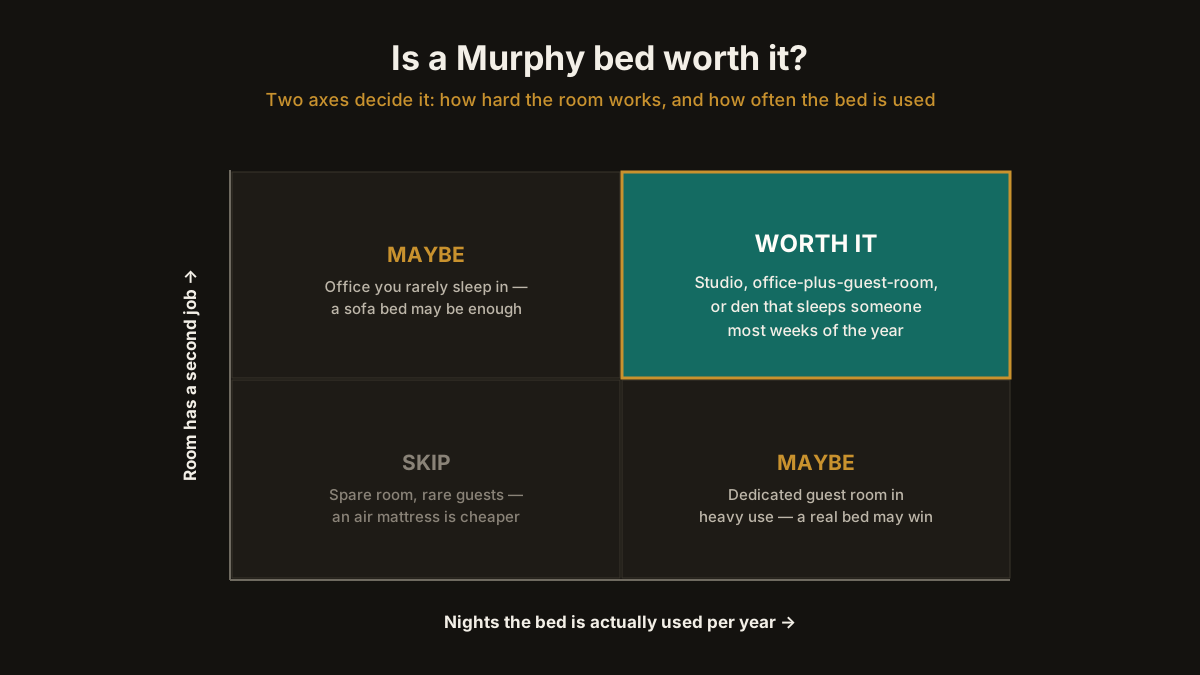
Worth it comes down to two numbers: how hard the room works, and how many nights the bed is actually slept in.
Short answer
A Murphy bed is worth it when a single room has to be a bedroom and something else — an office, a den, a living room — and the bed sees actual use. It's not worth it if you host once a year and could just get an air mattress, or if you sleep on it nightly and would be happier with a real bed frame. Match the tool to the frequency of use.
The one honest test
A Murphy bed is worth it when it converts a room from single-purpose to dual-purpose and you actually use both purposes. If the daytime use is theoretical and the guest use is rare, the math falls apart.
Ask yourself:
- Will the daytime function of the room happen at least three days a week?
- Will the bed be used at least ten nights a year (guest bed) or every night (primary bed)?
- Is the room genuinely too small to hold both a bed and a desk/couch/workspace?
Three yeses = Murphy bed is worth it. One or zero yeses = something simpler is better.
When a Murphy bed pays off
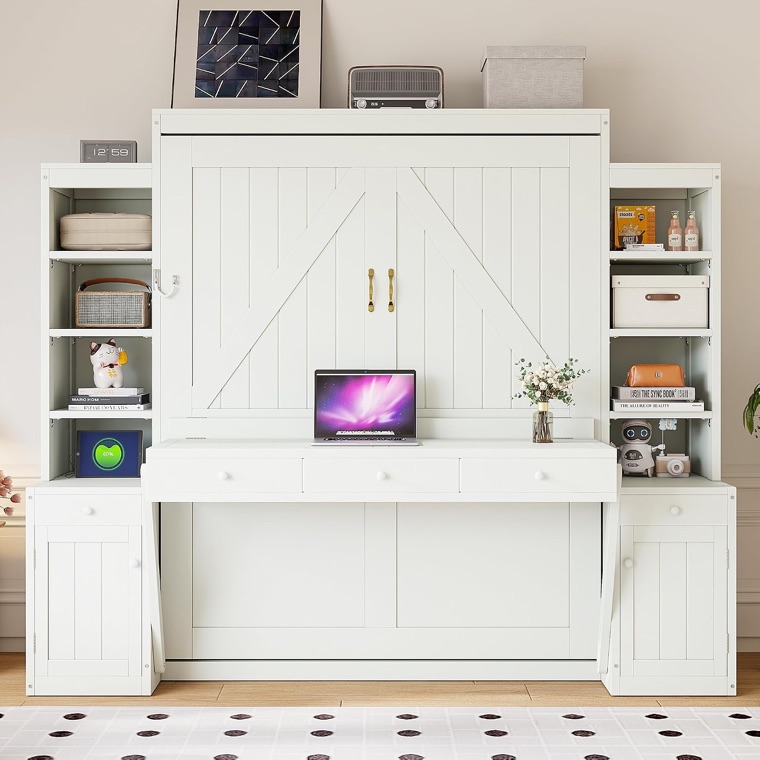
- Home office guest room. The room has to be a workspace every weekday and a guest room a few nights a month. A Murphy bed with a desk turns one room into both without either compromise.
- Studio apartment. No separate bedroom. A Murphy bed with a couch buys back the daytime living-room function you’d otherwise lose.
- Shared kids’ room. Two beds on the floor eats all the playable space. A dual-twin wall bed gives the room back for daytime use.
- Rental apartment with one bedroom. A cabinet bed in the living room adds a second sleep surface without a second bedroom.
- A den or bonus room that needs to become a bedroom occasionally without being one full-time.
- Airbnb or short-term rental. Every square foot of living room you preserve is a photo you can show. A cabinet bed is often the best ROI.
When a Murphy bed is not worth it
- Dedicated guest room that already exists. If a room can be a guest room all year, a normal bed frame is cheaper, more comfortable, and doesn’t need assembly.
- Guest use once or twice a year. A well-reviewed air mattress or a sofa pull-out is fine at this frequency. Murphy is over-engineered.
- Nightly primary bed with a real bedroom. Just buy a bed frame. A Murphy bed is a solution to a small-room problem, not an upgrade.
- Room where the daytime function is theoretical. “I might use it as an office someday” is not a reason to buy a Murphy bed.
- A ceiling under 82 inches with no room to go horizontal. Buy a cabinet bed instead, or don’t buy a Murphy at all — see the small-room guide.
Compared to the alternatives
| Alternative | When it wins vs Murphy bed | When Murphy wins |
|---|---|---|
| Sofa bed / sleeper sofa | You need seating, use overnight rarely | You need real overnight comfort |
| Air mattress | Guests visit once or twice a year | Guests visit monthly or more |
| Trundle bed | You have a real bed with a hidden second bed | You have no bed and need both a bed and a room |
| Daybed | The daybed’s daytime function (seating, reading) is enough | You need a desk or a real sofa |
| Bunk bed | Kids’ room, always two sleepers | You need floor space during the day |
| Normal bed frame | You have a dedicated bedroom | The room has to do more than one job |
The three-year total cost
A Murphy bed’s value comes from the square footage it hands back during the day. If your rent or mortgage assigns a real dollar figure to floor space, a Murphy bed that gives back 40 square feet a day pays for itself surprisingly fast in a high-cost-per-square-foot city.
In a house with plenty of rooms, it doesn’t. That’s why the “worth it” question is location-specific as much as room-specific.
Common regret triggers
- Bought queen when full would have done. Room feels crowded, bed feels no better.
- Bought a cabinet bed for a nightly primary sleep surface. Tri-fold mattress seams are noticeable within months.
- Bought a sofa wall bed for a room that never uses the couch. Paying for a sofa mechanism that gets ignored.
- Bought a mattress-included bed with a 4-inch mattress. Guests refuse to stay.
- Skipped the anchoring plan. Wall bed leans away from the wall over time.
Common wins
- Home office that doubles as a guest room — the number-one Murphy success story.
- Studio living room with a hidden queen — buyers routinely say it changed how the whole apartment works.
- Kids’ room dual-twin — floor stays open for play all day, both kids have a real bed.
- Airbnb den — extra “bedroom” without giving up the daytime living area.
Pre-purchase checklist
- Daytime function real, not theoretical
- Guest use at least ten nights a year, or nightly primary
- Alternative simpler than Murphy considered and rejected
- Room dimensions confirmed against the specific Murphy type
- Budget matched to frequency of use (guest room = mid-tier, primary bed = premium)
If you’re still on the fence, do the price math in how much is a Murphy bed and the format comparison in Murphy bed vs wall bed.