Configuration guide
Horizontal Murphy Beds: Side-Folding Wall Beds for Low Walls
A horizontal wall bed swings sideways, so a low or sloped ceiling stops being a dealbreaker.
Short answer
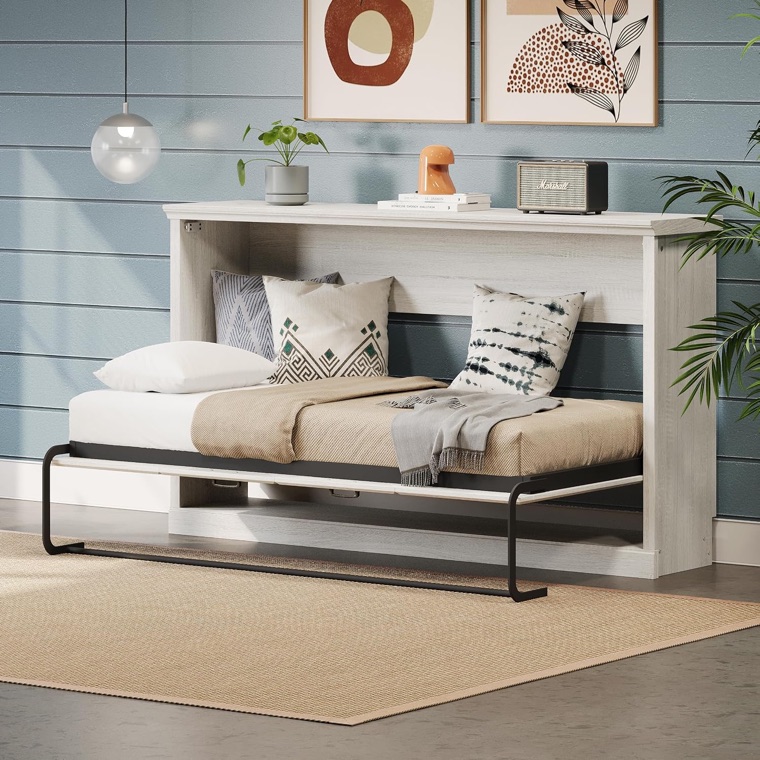
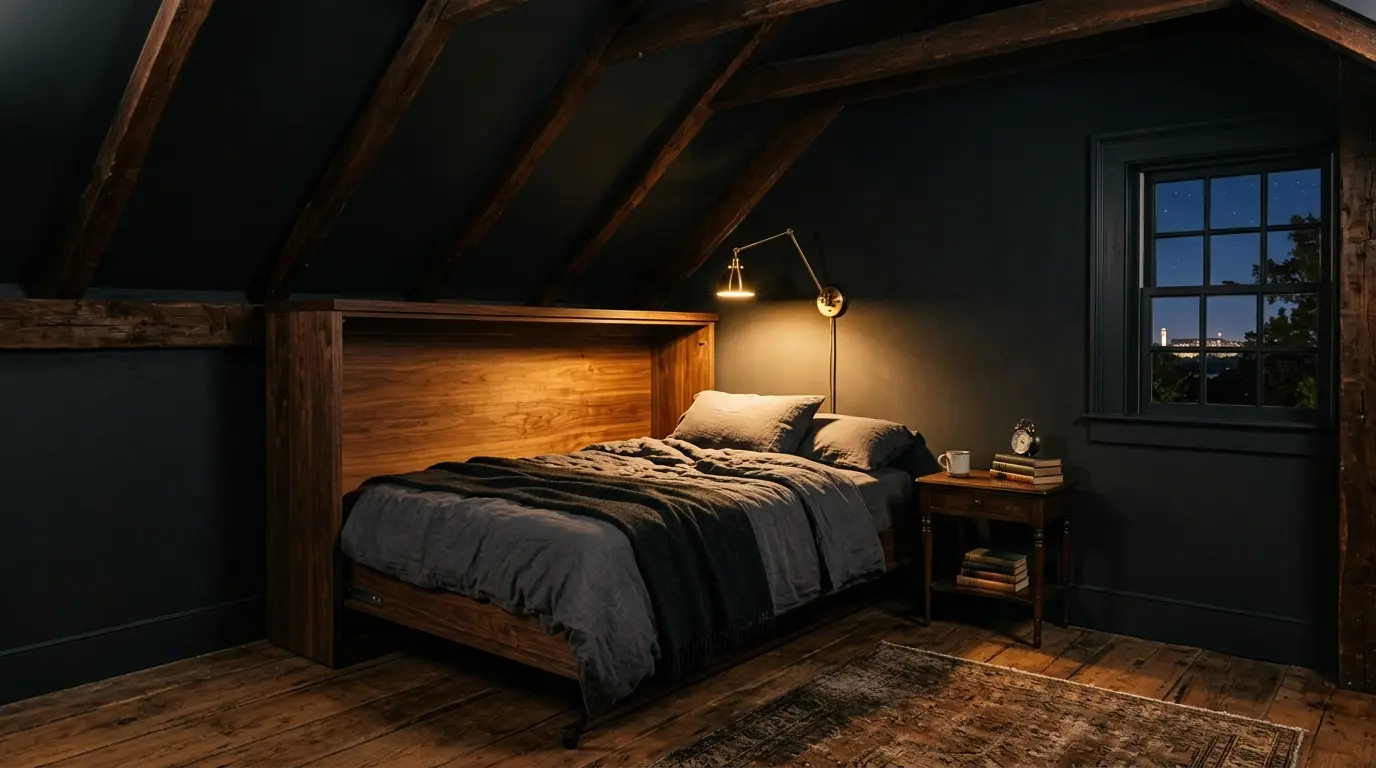
A horizontal Murphy bed folds the mattress out sideways instead of down toward you. The cabinet is short and wide, so the bed fits under sloped ceilings, above soffits, and against attic knee walls where a vertical unit won't stand up. The tradeoff is more wall width used and less choice in bigger sizes — most horizontal Murphy beds are twin, occasionally full.
The one problem horizontal Murphy beds solve
Vertical Murphy beds are the default because they use wall width efficiently. But every vertical bed needs vertical clearance — the cabinet has to be taller than the mattress is long. That’s about 82 inches for a twin and 88 inches for a queen.
A lot of rooms don’t have that height:
- Attic bedrooms with knee walls and sloped ceilings.
- Dormer nooks.
- Finished basements with soffits running across every wall.
- Manufactured homes and low-ceiling older houses.
In every one of those rooms, a vertical unit either won’t fit or has to be reinforced into a sloped ceiling — expensive, ugly, and often impossible. A horizontal Murphy bed solves it in one product.
How the mechanism works
The cabinet lies wide instead of tall. Inside is a twin (or occasionally full) mattress lying long-side-parallel to the wall. To open the bed, you swing the mattress and its platform out on hinges attached to the bottom of the cabinet. The bed ends up perpendicular to the wall, foot-out.
- Cabinet height: about 46 to 50 inches (fits under a low slope).
- Cabinet width: 80 inches or a bit more (for a twin — same as the mattress length).
- Cabinet depth: about 15 to 18 inches (about the mattress folded thickness).
- Open projection: about 40 inches into the room — much less than a vertical.
The gas struts do the work of holding the bed up; you tilt it out and the mechanism lowers it. Same drill in reverse to close.
Where horizontal really wins
The open projection difference is bigger than most buyers realize.
A vertical twin extends 75+ inches into the room. A horizontal twin extends only about 40 inches. In a narrow attic bedroom or a converted closet, that difference decides whether you can walk around the bed at all.
Horizontal Murphy bed vs vertical Murphy bed vs cabinet bed
| Factor | Horizontal wall bed | Vertical wall bed | Cabinet bed |
|---|---|---|---|
| Cabinet height needed | ~47“ | ~82“ (twin), ~88“ (queen) | Chest height (freestanding) |
| Wall width used | ~80“ | ~41“ (twin), ~65“ (queen) | ~65“ |
| Open projection | ~40“ | ~80“ | ~80“ |
| Sizes available | Twin mainly, some full | Twin, full, queen | Queen mainly |
| Best for | Low ceilings, attics, dormers | Standard rooms with wall space | Renters, no wall to drill |
The specs that decide the fit
Horizontal beds fail on floor swing clearance more than any other spec. Measure these:
- Cabinet height vs floor-to-ceiling at the install spot, including any slope over the cabinet.
- Wall width — the cabinet is long (~80“). It needs a wide enough wall.
- Swing clearance on the side the bed opens toward — plan the full mattress length, clear of furniture, doors, and radiators.
- Stud pattern — a horizontal wall bed loads the wall unevenly because most weight is on one side of the cabinet. Anchoring plan matters more here than on a vertical.
- Mattress thickness limit — usually 8 to 10 inches. Thicker mattresses won’t fold into the cabinet.
Common mistakes
- Forgetting the swing clearance. People measure the floor in front of the cabinet and forget the mattress swings sideways. That’s where dressers and doorways live.
- Buying horizontal for a normal-height room. If you have 82+ inches of ceiling, a vertical twin gives you back wall width and takes less floor. Horizontal is for constrained rooms.
- Anchoring to a non-structural knee wall. Attic knee walls are often partitions, not load-bearing. Confirm the wall type before anchoring anything heavy.
- Assuming queen is available. It usually isn’t in horizontal form. Adjust expectations to twin or full.
Pre-purchase checklist
- Cabinet height clears the ceiling (including slope) at the install point
- Wall width fits the 80“+ cabinet
- Swing side has 75“+ of clear floor (twin) or 80“+ (full)
- Stud or reinforcement plan for the anchoring load
- Mattress thickness limit confirmed
- Delivery path fits an 80“ long box (the box is long)
If the ceiling problem isn’t the reason you’re shopping, revisit vertical Murphy beds — you’ll get more size choices. If the room is genuinely tiny, the small-room Murphy bed guide covers the whole room layout.